Cross Contact
Steps to Avoid Cross Contact of Foods for Guests and Restaurants
Cross contact occurs in two primary instances and should be considered each and every time that you are ordering foods and/or serving individuals with gluten, wheat and allergen-free requirements.
-
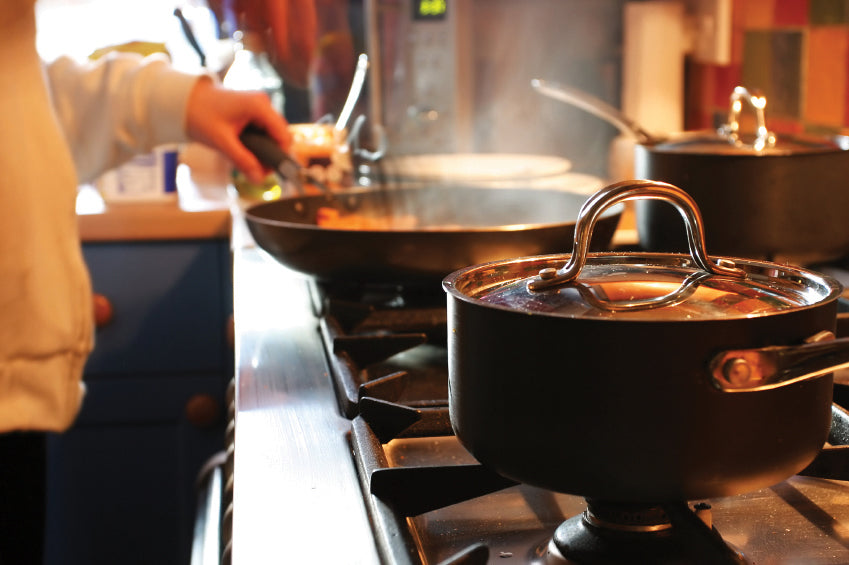 When the food item is prepared in the same frying oil or boiling water as other foods containing gluten or other common allergens.
 -
When microbes or food particles are transferred from one food to another by using the same knife, cutting board, pots, pans or other utensils without washing the surfaces or tools in between uses.
In the case of open flamed grills, extreme temperatures turn most food particles into carbon. Use of a clean wire brush designed for grill racks typically removes residual contaminants.
To avoid cross contact, you should use always make sure a dedicated fryer for gluten and wheat free foods is used, identify oils used for frying and monitor allergen foods prepared in a shared fryer.
Also, make sure all materials are washed that may come in contact with other foods in hot, soapy water prior to preparing items for those following gluten, wheat and allergen-free diets. Following these procedures will help to ensure safe dining experiences for everyone concerned.
Before your embark on your next adventure, we recommend that you also download one of our helpful travel books and/or mobile app to guide you during your planning process:
-
Let's Eat Out Paperback Book for 10 common food allergies or the Gluten Free Dining Out Toolbox Ebook for gluten and wheat concerns
-
Gluten Free and Allergy Free Travel Translation Cards: Effectively communicate your food concerns when ordering meals in foreign speaking countries
-
Listen to travel advice from Kim Koeller's interview with Women's Radio

A few questions that I frequently receive while presenting at conferences are if French fries are gluten free and how to ensure that there is no cross contact with other foods that contain gluten and other allergens.
I'd like to share with you some ideas and questions that you can ask restaurant staff while ordering your meals. These will help to ensure that your French fries are gluten free and that no cross contact mistakes are made.
From a French fry standpoint, potatoes are naturally gluten free. That being said, food preparation techniques in restaurants and fast food chains can impact if the French fries remain gluten free.
To avoid cross-contact, the restaurant should use a dedicated fryer for French fries to be gluten free. Ensuring a dedicated fryer is extremely important for those with gluten, wheat, dairy, fish and shellfish allergies so no cross contact from fried foods such as cheese sticks, breaded calamari and battered fish occurs.

Sample questions for safe gluten free French fries are:
-
"Are your French fries fried in the same fryer and oil as breaded items such as your chicken fingers and onion rings?"
-
"Do you use any packaged seasonings on your fries which contain gluten?"
-
"Do you flour dust your fries prior to frying?" (This is now a relatively rare cooking technique - it was used primarily in France to ensure that the fries would not stick together.)
If the answer to any of the three questions above is yes then the French fries are NOT gluten free.
NOTE: For gluten free fries at fast food restaurants, we recommend that you check the respective gluten free menu and/or allergy chart on your favorite fast food website or download our iCanEat Fast Food Gluten Free and Allergy Free Apple app.
The same type of dedicated fryer question holds true in Mexican restaurants: "Are your corn chips fried in the same fryer as your chimichangas?" If the answer is yes, then the corn chips are NOT gluten free due to the cross contact with the flour tortillas.
To avoid possible transference of food particles, a sample question is: "Do you use designated cutting boards, knives, pans and utensils when preparing my gluten free and allergy free dish?"

The staff must also wash all materials that may come in contact with food in hot, soapy water prior to preparing items for those following an allergen-free diet. You may also ask the staff to change their gloves prior to preparing your meal.
We have also included these cross contact considerations for French fries and other menu items in the iEatOut Apple app for ethnic restaurants, the Let's Eat Out Around the World books, as well as our gluten free translation cards, language phrase guides and country specific travel kits to help during your travels within the US and across the globe.
I hope that this advice helps you when eating out in restaurants close to home and abroad!
Key Preparation Techniques & Other Considerations
The following additional ingredients and preparation techniques represent areas of concern for those managing celiac disease and gluten free diets:
-
Batter typically contains gluten/wheat flour.
-
Beans may include wheat flour as an ingredient.
-
Boiling Water must be fresh in all cases to eliminate the possibility of cross-contact from water used to prepare gluten-containing items.
-

Breading typically contains gluten/wheat flour.
-
Dedicated Fryer is a fryer that only fries one particular food type (e.g. battered items only or French fries). Dedicated fryers eliminate the possibility of gluten/wheat cross-contact from frying battered, breaded or wheat flour dusted foods with non-gluten containing foods.
-
Flour Dusting is a technique used for coating meat or fish with an ingredient, such as gluten/wheat flour, for texture prior to pan-frying.
-
Fluffing Agent is a term used for adding an ingredient, such as gluten/wheat flour to eggs to enhance their appearance and increase their volume.
-
Fresh Oil is necessary for gluten-free food preparation to eliminate the possibility of cross-contact from cooking oil used for gluten-containing items.
-
Marinades may have soy sauce or packaged seasonings which contains gluten/wheat or gluten/wheat flour as an ingredient.
-
Side Dishes or Accompaniments can often contain gluten/wheat containing ingredients.
-
Thickening Agent is an ingredient, such as gluten/wheat flour, added to soups or sauces so they may have a higher viscosity or thickness.